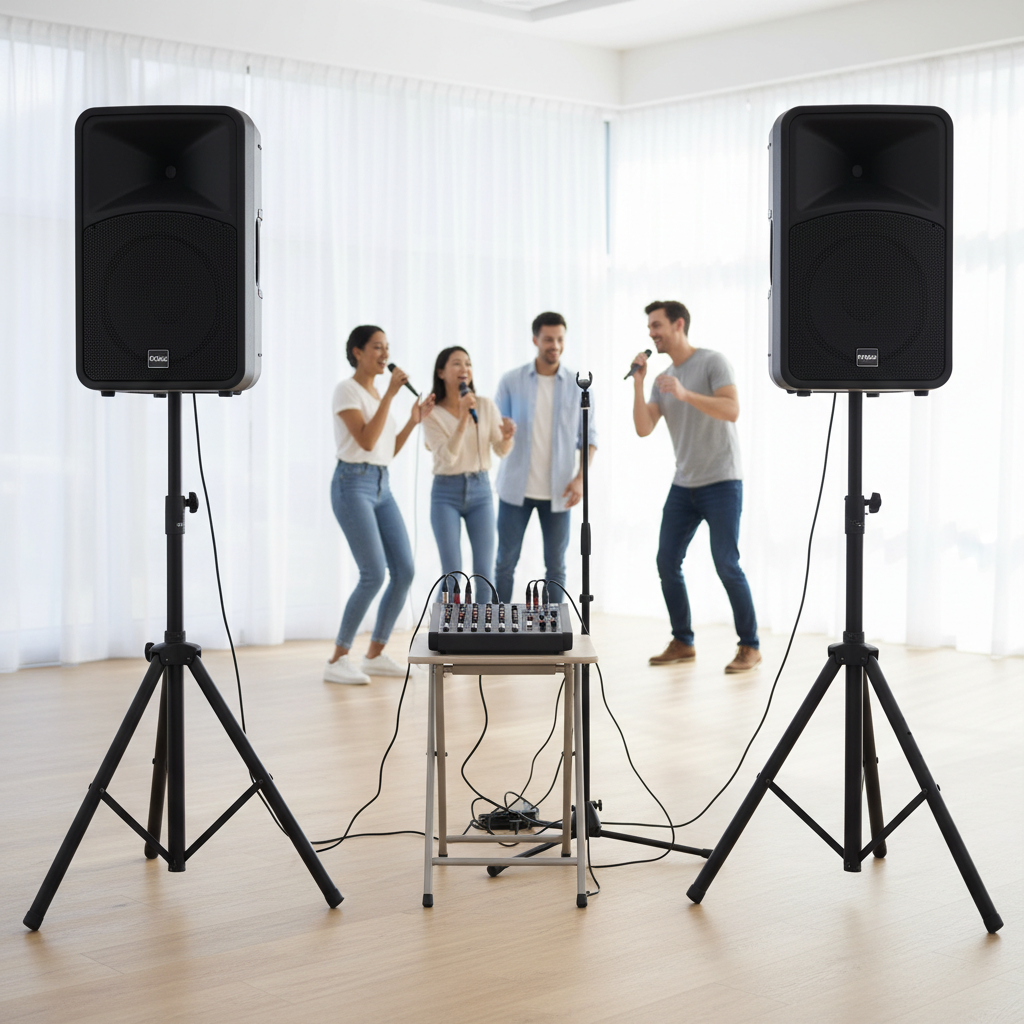
Stepping up to the microphone and belting out your favorite tunes is one of life’s great joys. But whether you’re performing for a packed hall or an intimate gathering at home, the heart of any unforgettable karaoke experience lies in your speaker system. Navigating the world of audio equipment can be daunting, especially when faced with the fundamental choice between active and passive speakers. With over a decade of hands-on experience in karaoke systems, I understand the challenges you face in selecting the right setup. This guide will cut through the jargon, giving you clear, practical insights to make an informed decision, ensuring your vocal performances truly shine in 2026 and beyond.
Understanding the Fundamentals: Active vs. Passive Karaoke Speakers
Before diving into comparisons, let’s clarify what truly distinguishes active and passive speakers. This foundational understanding is key to building a karaoke system that perfectly matches your needs and sonic aspirations.
What are Active Speakers?
|
Our Picks for the Best Karaoke system in 2026
As an Amazon Associate I earn from qualifying purchases.
|
||
| Num | Product | Action |
|---|---|---|
| 1 | JBL Wireless Two Microphone System with Dual-Channel Receiver, Black |

|
| 2 | NBVOICE Professional Portable All-in-One Integrated 2-Way PA System Fixed Setup, Suitcase Design w/ 8-Channel Mixer, 2 Speaker Stands, Bluetooth, Mic for Performances, Presentations |
|
| 3 | VOSOCO Karaoke Machine with 2 Wireless Microphones, Portable Bluetooth Speaker for Adults Kids, PA Systems Support TWS Echo Adjust TF USB AUX for Home Party Outdoor Travel |
|
| 4 | Karaoke Machine, Portable Bluetooth Speaker with 2 Wireless Microphones for Adults & Kids with Lights, Karaoke Microphone with PA System Supports USB/TF/REC/FM/AUX for Home Party Home System Packages |
|
| 5 | Karaoke Soundbar with Subwoofer for TV: Sound Bar with 2 Wireless Microphones - Home Theater Surround Sound System - Bluetooth Speaker with Remote Supports HDMI ARC/Optical/AUX/USB for TV/PC |
|
| 6 | Ikarao Smart Karaoke Machine for Adults - with Lyrics Display, 32GB Karaoke Tablet, 2 Wireless Mics, Professional Karaoke System, 300W Peak Power, 4 DJ Lights, Karaoke Speaker for Any Occasion |
|
| 7 | Karaoke Machine for Adults, Built-in 10.1" HD Lyrics Screen, Supports WiFi Bluetooth HDMI USB and TF, Portable Karaoke Player with 2 Wireless Microphones for Home Party Family Gathering |
|
| 8 | Portable Karaoke Machine, with Wireless Microphones, Bluetooth Party Speaker with LED Lights, Loud Subwoofer, USB/AUX, Outdoor Karaoke Speaker for Adults & Kids, Home & Party |
|
| 9 | Karaoke Machine, Portable Bluetooth 5.3 Speaker with 2 Wireless Microphones for Adults, PA System with Pitch Correction & Echo Adjustment, Supports TWS/TF Card/USB/AUX/Live for Home Party (2MICS) |
|
| 10 | Ikarao Portable Karaoke Machine for Adults, Built-in Lyrics Display and Screen, 2 Self-Charging Wireless Microphones, Karaoke App, 140W Speaker, Connects to TV for Home Party Birthday Outdoor Camping |
|
Active speakers, often referred to as “powered speakers,” are all-in-one units that have a built-in amplifier specifically designed to power their drivers. This means you can plug them directly into your audio source (like a mixer, karaoke machine, or even a smartphone) without needing a separate external amplifier. The internal amplifier is precisely matched to the speaker’s components, optimizing sound quality and efficiency, and often includes features like equalization (EQ) and digital signal processing (DSP) for fine-tuning your sound.
What are Passive Speakers?
In contrast, passive speakers require an external amplifier to function. They receive their power from this external amp, which must be connected between your audio source and the speakers. This traditional setup means the speaker itself is lighter and typically more compact, but the overall system requires additional components and wiring. The power from the external amplifier drives a “passive crossover network” within the speaker, which splits the audio signal into different frequency ranges (highs, mids, lows) and sends them to the appropriate drivers (tweeters, mid-range, woofers).
The “Powered” Speaker Nuance
While the terms “active” and “powered” speakers are often used interchangeably, there’s a subtle technical distinction that high-fidelity enthusiasts might note. True active speakers integrate the crossover before the amplification stage, allowing for precise control over each driver. “Powered” speakers, on the other hand, might have the crossover after amplification, similar to a passive setup but with the amplifier built into the cabinet. For most karaoke applications, this distinction is less critical, and “active speakers” generally refers to any speaker with a built-in amplifier.
Active Karaoke Speakers: The All-in-One Advantage
Active speakers have become incredibly popular, especially for those seeking convenience and consistent performance. They offer a streamlined approach to building a karaoke system.
Pros of Active Karaoke Speakers
- Simplicity and Ease of Use: With a built-in amplifier, active speakers are largely plug-and-play. You don’t need to worry about matching an amplifier’s impedance or wattage to your speakers, making setup much faster and easier, especially for beginners or mobile setups.
- Optimized Sound Quality: The integrated amplifier is designed specifically for the speaker’s drivers, ensuring optimal power delivery and minimal distortion. This synergy often results in a balanced and clear sound right out of the box, ideal for both music and clear vocal projection.
- Portability and Less Clutter: Eliminating the need for a separate amplifier means fewer components to transport and fewer cables to manage. This makes active speakers an excellent choice for mobile karaoke DJs, backyard parties, or simply reducing clutter in your home setup.
- Consistent Performance: Because the amplifier and speaker are perfectly matched, active speakers tend to deliver consistent sound performance every time they’re used. Many models also include built-in EQ settings and sometimes advanced DSP for sound shaping.
Cons of Active Karaoke Speakers
- Less Upgradeability: The integrated design means you’re generally stuck with the amplifier that comes with the speaker. If you want to upgrade your amplification, you’d have to replace the entire speaker. This limits customization options for audio enthusiasts who enjoy fine-tuning their system.
- Potential for Cheaper Components: At lower price points, some active speakers might use less robust internal amplifier components to keep costs down. This can sometimes lead to lower overall sound quality or potential reliability issues compared to a well-matched separate amplifier and passive speaker combination.
- Power Source at Each Speaker: Each active speaker requires its own power outlet, which can be a consideration for wiring in certain venues or outdoor settings.
- Higher Repair Costs: If the internal amplifier fails, repairing an active speaker can be more complex and potentially more expensive than simply replacing an external amplifier for a passive system.
Passive Karaoke Speakers: The Customizable Powerhouse
Passive speakers appeal to those who desire flexibility, control, and the ability to customize every aspect of their sound system.
Pros of Passive Karaoke Speakers
- Flexibility and Upgrade Path: This is where passive speakers truly shine. You have the freedom to choose your amplifier independently, allowing you to tailor the power, features, and sonic characteristics to your exact preferences. You can upgrade either the speakers or the amplifier separately, extending the life and potential of your system.
- Tailored Sound: Audiophiles and seasoned sound engineers often prefer passive systems because they can meticulously select an amplifier that complements the speakers’ specific characteristics, resulting in a highly personalized and refined sound.
- Durability and Repairability: Passive speakers are generally simpler in their internal electronics (no built-in amp to fail) and tend to be very robust. If an amplifier issue arises, you can simply replace the external amplifier, which can be less costly than repairing an internal one.
- Component Matching Potential: The ability to mix and match components allows for incredible precision in crafting a system. You can pair high-end speakers with a powerful, transparent amplifier to achieve superior audio fidelity.
Cons of Passive Karaoke Speakers
- Complex Setup: Setting up a passive system requires more knowledge. You need to understand concepts like impedance matching, power ratings, and proper wiring to ensure your amplifier and speakers work harmoniously and avoid damage.
- Additional Components and Cabling: Besides the speakers, you’ll need a separate power amplifier (and potentially a mixer, equalizer, or crossover unit), along with more cables. This increases the overall system’s footprint and complexity.
- Potentially Higher Initial Cost: While individual passive speakers might seem cheaper, the total cost often climbs once you factor in a quality external amplifier and all necessary cabling.
- Less Portable: Carrying separate speakers, an amplifier, and extra cables makes a passive system generally less portable than an active setup, which is a consideration for mobile karaoke hosts.
Factors to Consider When Choosing Your Karaoke Speakers in 2026
Making the right choice between active and passive speakers for your karaoke setup depends on several key considerations. Think of these as personalizing your audio journey.
Your Karaoke Environment: Where Will You Sing?
The space where you’ll be singing is paramount.
- Home Karaoke: For smaller living rooms or dedicated home karaoke spaces, active speakers often provide ample power and clarity with minimal fuss. For larger home theaters, a well-matched passive system can offer more immersive sound.
- Commercial Venue: Bars, clubs, or dedicated karaoke boxes might benefit from the modularity and power of passive systems, allowing for fixed installations and easier component replacement or upgrades over time.
- Mobile Setup/Outdoor Events: Active speakers, due to their all-in-one nature and portability, are usually the superior choice for mobile DJs or outdoor gatherings where quick setup and power accessibility are crucial. For outdoor use, speakers with at least 100 watts are recommended.
Budget & Investment: What Are You Willing to Spend?
Your budget influences whether you prioritize initial convenience or long-term flexibility.
- Initial Cost: Active speakers might appear more expensive per unit, but they include the amplifier. Passive speakers are cheaper individually, but adding a quality external amplifier and cabling can often make the total initial cost higher than an equivalent active system.
- Long-Term Value & Upgrades: Passive systems offer better long-term value for audiophiles, as you can upgrade components independently. Active systems provide good value for those who prefer a complete, hassle-free solution.
Sound Quality & Control: How Much Do You Want to Fine-Tune?
Vocal clarity is crucial for karaoke, regardless of speaker type.
- Vocal Enhancement Features: Look for speakers with features like echo control, feedback suppression, and balanced frequency response for clear midrange vocals. Daniel Ruiz, an audio engineer specializing in live sound consulting, emphasizes that “Most people focus on bass and volume… but midrange clarity and feedback suppression are what separate a fun moment from a frustrating one.”
- Built-in EQ/DSP: Many active speakers come with built-in equalization (EQ) and digital signal processing (DSP) to shape the sound to room acoustics or personal preference. Passive systems rely on external mixers or EQs for this control.
Setup Complexity & Portability: Plug-and-Play or Modular Mastery?
Your comfort level with audio wiring and your need for mobility are key.
- Plug-and-Play: Active speakers are ideal for those who want a straightforward, quick setup.
- Modular Control: Passive systems offer greater control over each component but demand more time and knowledge for proper configuration.
Expandability & Future-Proofing: Growing Your System
Consider if you plan to add components later.
- Adding Subwoofers: Both active and passive systems can accommodate subwoofers, but passive systems offer more direct control over crossover points and power distribution.
- Upgrading Components: Passive systems excel here, allowing you to upgrade your amplifier or speakers independently without replacing the entire setup.
Durability & Reliability: Built to Last
For frequent use or transport, durability is essential. Both types can be durable, but passive systems may be easier to service in case of amplifier failure since the amp is external.
Detailed Comparison: Active vs. Passive Karaoke Speakers
Here’s a comprehensive look at how active and passive speakers stack up against each other for karaoke use:
| Feature | Active Karaoke Speakers | Passive Karaoke Speakers |
|---|---|---|
| Amplification | Built-in (matched to drivers) | External (separate component) |
| Crossover | Active (before amplification, optimized) | Passive (after amplification, within speaker) |
| Setup Complexity | Low (plug-and-play) | High (requires matching amp and wiring) |
| Flexibility | Low (fixed components) | High (mix-and-match amp and speakers) |
| Portability | High (fewer components, less cabling) | Low (more components, more cables) |
| Initial Cost | Often higher per speaker, but all-inclusive | Lower per speaker, but higher when amp is added |
| Sound Optimization | Factory-tuned for specific drivers | Customizable through amp choice |
| Upgrade Path | Limited (replace entire speaker) | Excellent (upgrade amp or speakers independently) |
| Cabling | Power cable + signal cable per speaker | Speaker cables + amp power cable + signal cables |
| EQ/DSP | Often built-in | Relies on external mixer/processor |
| Repair | Internal amp failure means speaker repair | External amp failure means amp replacement |
Expert Tips for Optimal Karaoke Sound
Beyond choosing the right speaker type, these insights will elevate your karaoke experience:
“Most people focus on bass and volume… but midrange clarity and feedback suppression are what separate a fun moment from a frustrating one.” – Daniel Ruiz, Audio Engineer, Live Sound Consulting.
- Prioritize Vocal Clarity: While powerful bass is great for music, ensure your speakers deliver clear, articulate midrange frequencies for vocals.
- Control Feedback: Proper microphone technique and speaker placement (behind or to the sides of microphones, not directly in front) are essential to prevent howling feedback. Many karaoke speakers have built-in feedback suppression.
- Consider Room Acoustics: Hard surfaces can cause echoes. Soft furnishings, carpets, and curtains can help absorb sound and improve clarity.
- Match Components (for Passive Systems): If you go passive, pay close attention to the amplifier’s power output (wattage) and impedance (ohms) to ensure it perfectly matches your speakers. Mismatching can damage equipment or result in poor sound.
Common Issues with Karaoke Speakers and Troubleshooting
Even with the best equipment, occasional glitches can happen.
- Sound Distortion: Often caused by overdriving the amplifier (too high volume), improper gain staging, or a faulty cable. Reduce volume, check connections, and ensure your input levels aren’t peaking.
- Feedback: The notorious screeching sound. This occurs when microphone sound loops back into the microphone from the speakers. Move speakers further from microphones, point them away from the mic, or use a feedback suppressor.
- Connection Problems: Loose cables, incorrect inputs, or faulty connectors can lead to intermittent sound. Always check all physical connections first.
Conclusion
Choosing between active and passive karaoke speakers in 2026 ultimately boils down to your personal priorities: convenience versus customization. Active speakers offer a straightforward, all-in-one solution with optimized sound and easy portability, perfect for casual users and mobile setups. Passive speakers, on the other hand, provide unparalleled flexibility and upgradeability, allowing audiophiles to craft a meticulously tailored sound system for fixed installations or professional use.
Consider your budget, technical comfort, performance environment, and long-term aspirations. Whichever path you choose, investing in quality speakers that prioritize vocal clarity and balanced sound will transform your karaoke sessions from good to legendary. So, are you ready to hit that high note? What kind of unforgettable karaoke memories will you create with your new system?
Frequently Asked Questions
Which type of speaker is better for a beginner karaoke setup?
For beginners, active karaoke speakers are generally recommended. Their built-in amplification and plug-and-play simplicity eliminate the need for complex wiring and component matching, making setup quick and hassle-free, allowing you to focus on the fun of singing.
Can I mix active and passive speakers in a single karaoke system?
While technically possible with the right mixer and signal routing, it’s generally not recommended for a standard karaoke setup. Combining active and passive speakers can complicate gain staging and impedance matching, potentially leading to uneven sound and difficulty in troubleshooting.
Do active speakers have better sound quality than passive speakers?
Not inherently. While active speakers benefit from factory-optimized amplifier-to-driver matching, high-end passive systems paired with a meticulously chosen, powerful external amplifier can achieve superior sound quality and greater sonic transparency due to the ability to select premium, dedicated components.
What wattage should I look for in karaoke speakers?
For home use in an average room, 50-100 watts per speaker is usually sufficient. For larger rooms, halls, or outdoor events, aim for 100 watts or more per speaker to ensure clear, impactful sound without distortion. Vocal clarity in the midrange is often more important than sheer volume.
Are wireless karaoke speakers active or passive?
Most wireless karaoke speakers, especially portable models, are active speakers. They typically have built-in amplifiers and may include Bluetooth or Wi-Fi connectivity, allowing for a cable-free connection to your music source while still requiring a power outlet or internal battery.
How important is feedback suppression for karaoke speakers?
Feedback suppression is very important for karaoke, as it helps prevent the irritating screeching sound that occurs when a microphone picks up its own amplified sound. While proper mic technique and speaker placement are primary defenses, speakers with built-in feedback suppression can offer an additional layer of protection for a smoother performance.
Can I use regular home stereo speakers for karaoke?
You can, but it’s generally not ideal. Home stereo speakers are designed for music playback, not high-volume vocal amplification, and may lack features like microphone inputs, echo effects, and robust construction to handle the demands of karaoke, potentially leading to damage or poor vocal clarity.